The best ABM agency for HubSpot is the one that can fix your data before it builds your campaigns. For enterprise teams, account-based marketing rarely fails on creative or targeting.
It fails because account hierarchies are wrong in the CRM. After all, intent signals never reach the sales team in a usable form, and nobody agreed in advance what counts as an engaged account.
So the evaluation criteria that matter are not the ones most agencies lead with.
This guide sets out what enterprise marketing leaders should look for, the questions worth asking in a first conversation, and the failure modes to screen for before you sign anything.
What does an ABM agency for HubSpot actually do?
A HubSpot ABM agency should cover four things. Most cover one or two well and describe the rest.
- CRM and data foundations. Account hierarchies, parent-child relationships across subsidiaries, deduplication, firmographic enrichment, and target account list governance inside HubSpot.
- Platform configuration. HubSpot’s native ABM tooling — target account properties, ideal customer profile tiering, buying roles, account-based workflows and the ABM dashboards — plus integration with any third-party intent or advertising platform in the stack.
- Programme design and execution. Segmentation, content and offer strategy per tier, channel orchestration, and the sales plays that sit alongside the marketing activity.
- Measurement. Account-level engagement scoring, influenced pipeline reporting, and attribution that a CFO will accept.
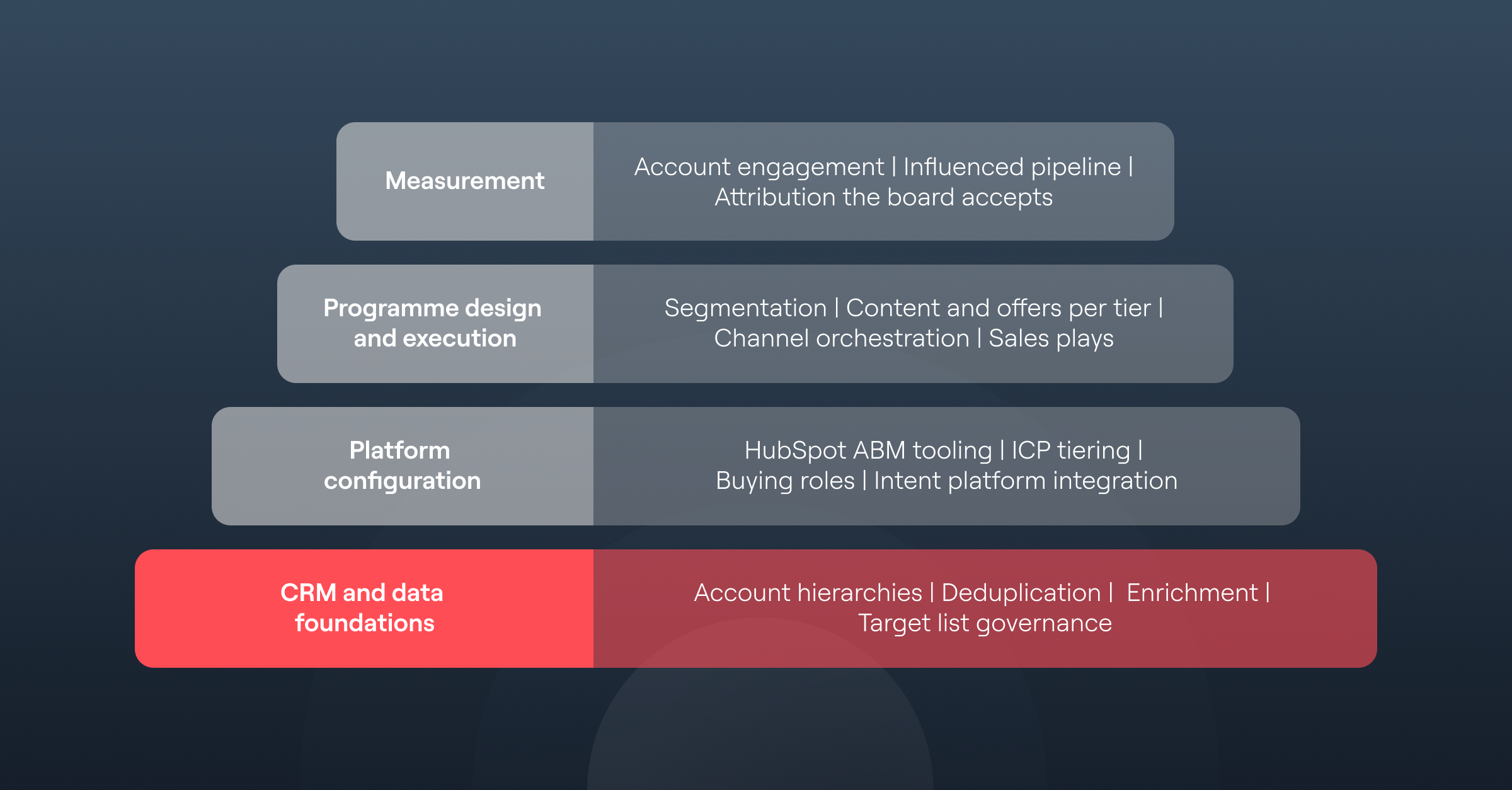
An agency strong on the third point and weak on the first will produce campaigns that look good in a monthly report and generate very little pipeline. That is the single most common outcome of enterprise ABM, and it is a scoping failure rather than an execution one.
What should enterprise buyers look for in a HubSpot ABM agency?
Eight criteria, in rough order of how much they predict the outcome.
1. Certified depth in HubSpot, not just familiarity
HubSpot’s Solutions Partner tiers run from Gold up to Elite, and Elite is a small group. For enterprise ABM, you also want to see specific accreditations in the hubs your programme depends on — typically Marketing Hub and Sales Hub at Enterprise level, plus Operations Hub if data quality work is in scope.
Ask which named consultants would be on your account and what they hold, rather than what the agency holds in aggregate.
2. Genuine CRM and data engineering capability
This is the criterion that separates outcomes. Ask how the agency would handle a target account list where the same global parent appears eleven times under different legal entity names.
If the answer is a manual clean-up, you will be paying for that clean-up again in eighteen months. If the answer involves association labels, a deduplication rule set and an ongoing enrichment process, you are talking to someone who has done this at scale.
3. Integration capability with your intent and advertising stack
Most enterprise ABM programmes run HubSpot alongside at least one specialist platform — Demandbase, 6sense, or LinkedIn’s account targeting. The value is not in owning both systems.
It is in whether intent signals arrive in HubSpot in a form a sales rep will act on, and whether engagement flows back out to keep audiences accurate. Ask to see how that bi-directional sync is built and what happens when it breaks.
4. Sales-side capability, not marketing alone
ABM is a joint motion. An agency that cannot help you design the sales plays, the SLA between the two teams, and the alerting that tells a rep an account is warming will hand you a marketing programme with an ABM label on it.
Ask what they would put in place so that a rep knows, on a Monday morning, which three accounts to call and why.
5. Multi-region delivery, if you need it
Enterprise ABM across EMEA, North America and APAC brings language, data residency and time zone constraints that a single-market agency will underestimate. If your target account list spans regions, ask where delivery staff actually sit and how regional variation in messaging and compliance is handled.
6. Measurement you can take to the board
Engagement scores are an internal management tool. What a CFO wants is influenced pipeline, deal velocity within target accounts, and account penetration over time.
Ask the agency to show you the reporting model they would build in HubSpot, before the engagement starts, and check that it produces numbers you would be comfortable defending.
7. A credible post-launch operating model
ABM programmes degrade. Target lists go stale, buying committees change, and messaging that worked in Q1 stops working by Q4.
The question to ask is what the engagement looks like in month nine. An agency built around project delivery will have a thinner answer than one built around ongoing operation.
8. Security and governance credentials
Enterprise ABM means handling firmographic and behavioural data on named individuals at named companies, often across jurisdictions. Independent certification is the cheapest signal available that an agency handles this properly.
Ask specifically which standards the agency is certified against, and check the certification is current and covers the entity that will do your work.
Why does ABM fail in HubSpot?
Five failure modes account for most of it. Each one maps back to a question you can ask during evaluation.
- Account hierarchies were never modelled, so a global target account looks like a dozen unrelated companies and reporting cannot roll up.
- Target account lists were built once and never governed, so within two quarters they no longer reflect who sales is actually pursuing.
- Intent data arrives but has no home. Signals sit in a separate platform, sales never sees them, and the subscription gets cancelled at renewal.
- Marketing and sales never agreed a definition of an engaged account, so handover is inconsistent and neither team trusts the other’s numbers.
- Measurement was designed after launch rather than before it, which makes influenced pipeline impossible to reconstruct retrospectively.
An agency worth hiring will raise most of these before you do.
What should you ask a HubSpot ABM agency before signing?
Ten questions that surface capability rather than positioning.
- Which named consultants will work on our account, and what HubSpot accreditations do they hold?
- How would you model our account hierarchy in HubSpot, given our subsidiary structure?
- What is your process for governing the target account list after launch?
- How would you get intent signals in front of our sales team in a form they will act on?
- What sales plays would sit alongside the marketing activity, and who designs them?
- What does the reporting model look like, and can we see it before we commit?
- What does month nine of this engagement look like compared with month one?
- Where does your delivery team sit, and how do you handle our regional requirements?
- Which security and quality standards are you independently certified against?
- What would make you tell us we are not ready for ABM yet?
The last question is the most useful one. An agency that has never turned work down has not been asked to think about readiness.
How do you know if your HubSpot setup is ready for ABM?
Before you brief an agency, four things are worth checking yourself.
- Data quality. Can you produce a clean, deduplicated list of your top 100 target accounts from HubSpot today, with the right parent-child relationships in place?
- Contact coverage. For those accounts, do you hold contacts across the full buying committee, or only the one person who downloaded something in 2023?
- Sales alignment. Would your sales leadership recognise that target account list as the one their team is working?
- Licensing. HubSpot’s account-based tooling sits at Marketing Hub Professional and above, with the fuller feature set at Enterprise. Confirm what your subscription actually includes.
If the first two are shaky, the honest sequence is data work first and campaigns second. Any agency that tells you otherwise is selling you the part they enjoy.
How Huble approaches HubSpot ABM
Huble is a HubSpot Triple Elite Solutions Partner and was named HubSpot’s 2024 Global Partner of the Year. Our ABM work starts with the CRM foundations rather than the campaign calendar, because that is where enterprise programmes are usually won or lost.
We build ABM inside HubSpot with the data architecture underneath it — account hierarchies, target account governance, buying committee coverage — and integrate the intent and advertising platforms that sit alongside it so signals reach sales in a usable form.
Delivery runs across EMEA, North America and APAC, which matters when a target account list crosses regions.
On governance, we are independently certified against ISO/IEC 27001:2022 (information security), ISO 9001:2015 (quality management) and ISO/IEC 42001:2023 (AI management).
The last of those is still rare among HubSpot partners and is worth asking about wherever AI is used on your account data.
If you want a view of where your own setup stands before you brief anyone, our ABM fit assessment works through the readiness questions above.
Frequently asked questions
What is an ABM agency for HubSpot?
An agency that designs and runs account-based marketing programmes inside HubSpot, covering CRM data foundations, platform configuration, programme execution and measurement.
The strongest ones treat data architecture as part of the engagement rather than a prerequisite you are expected to have solved.
How much does a HubSpot ABM programme cost?
Cost depends on the number of target accounts, how much data remediation is needed first, and whether third-party intent platforms are in scope.
Data foundations work is the most commonly underestimated line. Ask any agency to price that separately so you can see it.
Do I need HubSpot Marketing Hub Enterprise for ABM?
HubSpot’s account-based tooling is available from Marketing Hub Professional upwards, with the fuller feature set — including more advanced target account reporting — at Enterprise.
Confirm what your current subscription covers before scoping a programme.
How long before an ABM programme shows results?
Enterprise sales cycles set the floor. Account engagement signals usually move within the first quarter, but influenced pipeline follows your normal deal cycle.
Agree in advance which leading indicators you will judge the programme on before revenue lands.
Should we choose a HubSpot partner or a specialist ABM agency?
If your programme lives in HubSpot, a certified HubSpot partner with genuine ABM capability avoids the handover problem between the agency that runs the campaigns and whoever maintains the CRM.
If you run ABM largely outside HubSpot, the calculation changes.
What is the difference between ABM and demand generation?
Demand generation works a broad market and filters down. ABM starts from a defined list of named accounts and works to penetrate each one across a buying committee.
Most enterprise teams run both, with ABM concentrated on the highest-value tier.



.png?width=500&height=320&name=Image_1__How_to_Get_Your_Brand_Cited_in_AI_Search_in_6_Simple_Steps_(2026).png)