.png?width=1600&height=800&name=Image_1__Why_CRM_Implementations_Fail_(And_What_Enterprise_Teams_Can_Do_About_It).png)
CRM technology works. CRM adoption doesn’t.
That’s the uncomfortable truth behind a set of statistics that should concern any enterprise investing in CRM: industry data consistently shows that 20–70% of CRM projects fail to meet their goals. Johnny Grow’s research puts the number at 55%. Forrester reported 47%. Harvard Business Review aggregated a dozen analyst reports and found failure rates ranging from 18% to 69%.
The instinct is to blame the platform. If the CRM isn’t delivering, the answer must be a better CRM. But in most cases, the platform was never the problem. Over 60% of CRM failures are attributed to people-related challenges, rather than technology.
Only 6–10% stem from the actual platform itself. The rest is process, communication, and organisational change; the things that get deprioritised when the implementation timeline gets squeezed.
This post is for CMOs, CROs, and VP-level leaders at companies with 200 or more employees who are implementing, migrating, or re-implementing CRM. If you’re moving from Salesforce or Dynamics to HubSpot, rolling out HubSpot for the first time, or trying to fix an implementation that underdelivered, the patterns of failure (and success) are remarkably consistent.
What CRM Adoption Failure Actually Looks Like
The symptoms tend to be obvious in hindsight but easy to miss in real time. Here’s what we typically see:
Sales teams build shadow systems. Reps maintain personal spreadsheets, notebooks, or Notion databases alongside the CRM because the CRM feels like overhead rather than a tool that helps them sell. They enter the minimum required data to satisfy reporting requirements and do their real work elsewhere.
Data quality erodes quietly. Records become incomplete, duplicated, or outdated. Pipeline forecasts become unreliable; not because the forecasting methodology is wrong, but because the underlying data is garbage. 76% of CRM users say less than half of the data in their system is accurate.
The CRM becomes a management reporting tool. It’s used to pull board decks and activity reports, but nobody relies on it for day-to-day decision-making. The tool serves leadership, not the people doing the work.
Marketing teams plateau on familiar features. They’re running emails, blogs, and social media, the things they’re comfortable with, but they’re not adopting AI agents, advanced automation, or newer platform capabilities that could transform how they work. The platform grows; the usage doesn’t.
Training is completed, but behaviour doesn’t change. Everyone attended the webinar. Everyone passed the knowledge check. And three months later, nothing is different. This is perhaps the most telling symptom of all.
Why This Keeps Happening
When we work with enterprise teams on CRM implementation, the root causes of poor adoption follow predictable patterns. These aren’t platform problems; they happen regardless of whether you’re running HubSpot, Salesforce, or Dynamics.
Unclear responsibilities between the implementation partner and the client
Most CRM implementations involve a third-party partner (like Huble) working alongside the client’s internal teams. When the division of responsibility for change management isn’t defined early, it falls through the cracks. The partner focuses on configuring the platform.
The client assumes the partner is handling adoption. Neither side owns change management explicitly, and it shows in the outcome.
No stakeholder mapping
People get brought into the project too late. Key stakeholders aren’t consulted during the design phase, and the result is a system that doesn’t fit how certain teams actually work.
This doesn’t just cause friction; it can derail the project entirely when a senior leader or department head pushes back after go-live on a setup that was never designed for their needs.
Poor communication planning
Communication about the CRM change is often treated as an afterthought. Who are we communicating with? When do people first hear about the change? Is there resistance in the organisation? Who’s for it, who’s against it, who’s on the fence?
These questions should be answered before a single workflow is configured. They rarely are.
Training as an afterthought
Training typically happens at the end of the implementation as a series of webinars, a feature walkthrough compressed into a few sessions. But CRM adoption isn’t a knowledge problem.
It’s a behaviour change problem. Knowing where the buttons are doesn’t change whether someone uses them. And yet most implementations treat training as the finish line rather than the starting point of adoption.
The Real Challenge: Changing Habits
This is the part most implementation partners and internal project teams get wrong. CRM adoption is fundamentally about changing habits.
And habits are incredibly hard to change.
Getting a sales team to input data into a CRM isn’t a training exercise. It’s a behavioural science challenge. You’re asking someone to interrupt their established workflow, do something that feels like admin, and trust that it’ll be worth the effort. If you don’t make that new behaviour low-friction, immediately rewarding, and socially reinforced, it won’t stick.
This is where gamification and behavioural science come in. Successful CRM adoption drives 41% higher revenue per salesperson on average, but getting there requires understanding why behaviour changes (or doesn’t). Becky Harris explores how these behavioural principles drive CRM adoption in Huble’s CRM adoption webinar.
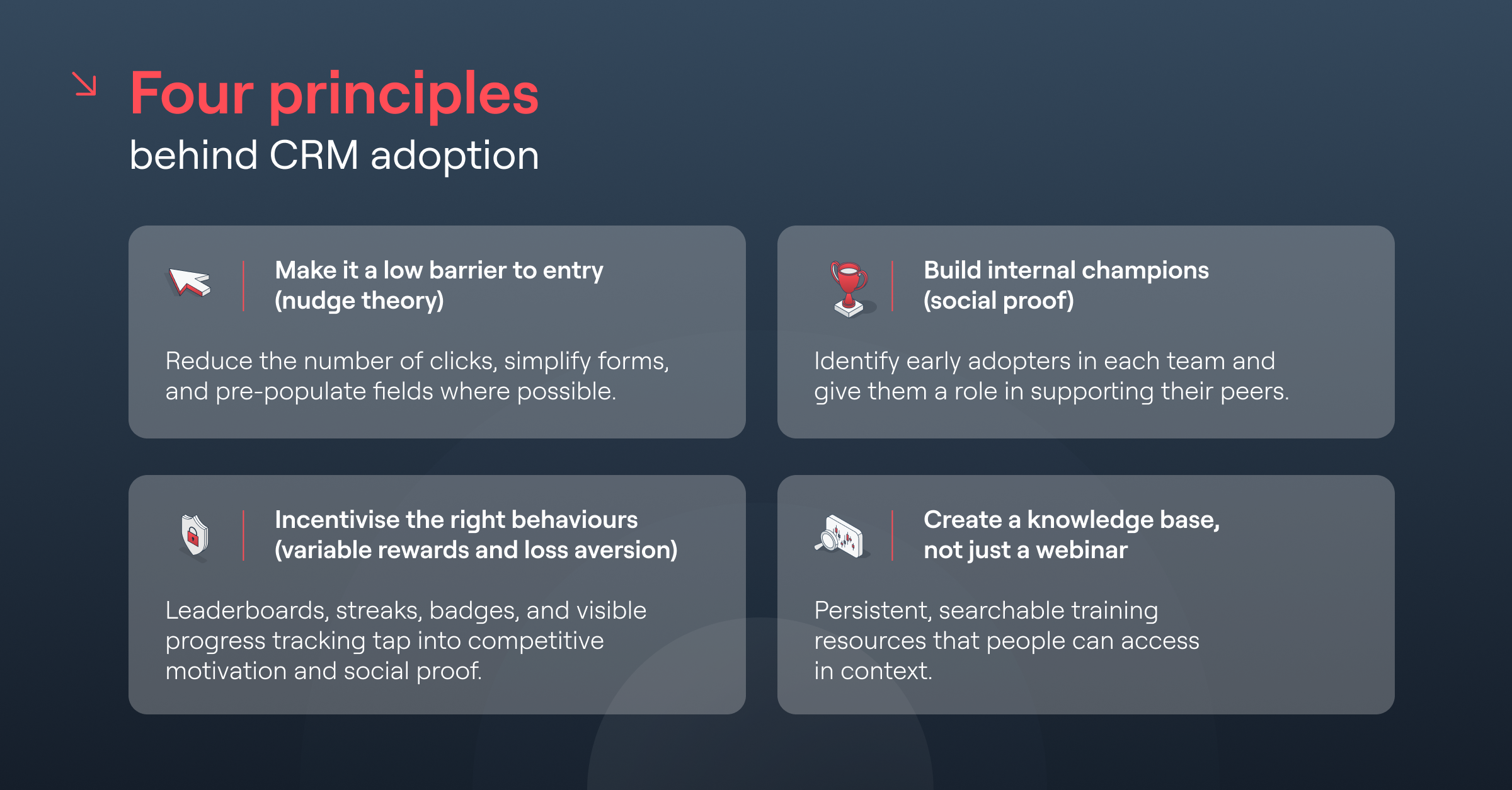
The research is clear: nudge theory (Thaler & Sunstein), variable rewards (B.F. Skinner), loss aversion (Kahneman & Tversky), and social proof all apply directly to CRM adoption. The most successful adoption programmes we’ve built don’t rely on top-down mandates or compliance monitoring.
They apply these principles systematically:
Make it a low barrier to entry (nudge theory). Reduce the number of clicks, simplify forms, and pre-populate fields where possible. If data entry feels effortless, people do it. If it feels like bureaucracy, they don’t.
Incentivise the right behaviours (variable rewards and loss aversion). Leaderboards, streaks, badges, and visible progress tracking tap into competitive motivation and social proof.
Streaks work because consistency is psychologically addictive; a rep on a four-day CRM activity streak doesn’t want to break it. Leaderboards create friendly competition. Badges reward micro-milestones. And because losing progress feels twice as painful as gaining it (loss aversion), these mechanics sustain behaviour far longer than a mandate from management.
Build internal champions (social proof). Identify early adopters in each team and give them a role in supporting their peers. People adopt tools faster when they’re coached by someone who does their job, not by someone from IT or an external consultant.
Create a knowledge base, not just a webinar. Persistent, searchable training resources that people can access in context: when they’re trying to do a task, not three weeks before they need to, sustain adoption far better than one-time sessions.
Why This Is Getting Harder, Not Easier
AI is making the adoption challenge worse, not better. Platforms like HubSpot are introducing powerful AI features, including Breeze agents for prospecting and content, AI-powered forecasting, and automated data enrichment. However, the gap between what’s available and what teams actually use is growing.
At the same time, attention spans are dropping, digital adoption isn’t keeping up, and a workforce increasingly composed of Gen Z and Millennials expects technology to be intuitive, rewarding, and fast. If your CRM doesn’t feel like the consumer apps your team uses every day, they won’t use it, no matter how powerful it is.
The pattern mirrors what happens with any new platform capability: the features launch, early adopters experiment, and most of the organisation continues doing things the way they’ve always done them.
Unless change management explicitly addresses AI adoption by showing teams how these features integrate into their existing workflows, reducing the perceived risk of using them, and demonstrating tangible results, the investment in AI-capable CRM is wasted.
For CMOs and CROs, the question isn’t just ‘are people using the CRM?’ but ‘are people using the CRM the way we need them to?’ If your marketing team is running emails and blogs but ignoring Breeze agents, or your sales team is logging calls but not using AI-assisted prospecting, you have an adoption problem even if your login metrics look healthy.

How to Spot Adoption Problems Early
If you’re a VP, CMO, or CRO reading this, here are the signals that suggest your CRM implementation has an adoption problem, even if nobody’s complained:
Login counts look fine, but data completeness is declining. People are logging in because they have to. They’re not filling in the fields that matter.
Time from lead creation to first sales activity is increasing. The CRM is creating leads, but reps aren’t actioning them quickly because they’re working from a different system.
Support tickets spike after go-live, then flatline. The spike is expected. The flatline isn’t healthy; it often means people have stopped trying to use the system properly, not that they’ve mastered it.
Teams build workarounds instead of using built-in features. If departments are exporting data to manipulate in spreadsheets rather than using reporting dashboards, the CRM isn’t embedded in workflow.
New features go unused. The platform ships new capabilities quarterly. If nobody’s adopting them, your change management isn’t ongoing; it was a one-time event.
How Huble Approaches CRM Change Management
Most implementation partners treat change management as a bolt-on; a training phase at the end of a technical project. At Huble, change management is embedded in the delivery model from day one.
That means stakeholder mapping happens before platform configuration, not after. Communication planning is a workstream, not a memo. Training is role-based and workflow-specific, not a generic webinar.
And adoption governance (measuring what’s actually being used and by whom) continues well past go-live through our Huble Flex retainer model.
We’re building on this with a structured change management framework launching later this year, codifying the approach we’ve refined as a HubSpot Triple Elite Partner and HubSpot’s 2024 Global Partner of the Year.
It includes specific gamification methods, like streaks tracked via custom properties and Slack notifications, leaderboard dashboards built natively in HubSpot, badge systems using custom objects, and workflow-triggered nudges for stalled deals, all grounded in behavioural science principles that drive real adoption, not just CRM login.
Whether you’re implementing HubSpot for the first time, migrating from Salesforce or Dynamics 365, or trying to recover a CRM deployment that didn’t stick, the adoption challenge is the same. The technology is rarely the problem. The people strategy is.
Frequently Asked Questions
What is CRM change management?
CRM change management is the structured approach to ensuring that people in your organisation actually adopt and use a new or updated CRM system. It covers stakeholder engagement, communication planning, training design, resistance management, and post-go-live adoption governance. It’s the people side of a technology implementation.
Why do CRM implementations fail?
Most CRM failures are people-related, not technology-related. Over 60% of failures relate to user adoption, poor communication, unclear responsibilities, and insufficient training.
Only 6–10% are caused by the platform itself. The most common root causes are a lack of executive sponsorship, no stakeholder mapping, training treated as an afterthought, and no ongoing adoption governance after go-live.
How long does CRM adoption take?
Initial adoption typically happens in the first 30–90 days after go-live, but sustainable adoption, where the CRM is genuinely embedded in daily workflows, takes 3–6 months. The highest-risk period is months 3–6 when initial training fades, and old habits reassert themselves.
Ongoing change management and adoption governance are critical during this window.
What is a CRM champions programme?
A champions programme identifies early adopters within each team and gives them a role in supporting their peers. Champions are typically power users who are enthusiastic about the platform and can provide in-context help to colleagues. They bridge the gap between the implementation partner’s formal training and the day-to-day reality of how each team works.
How do you measure CRM adoption success?
Effective adoption measurement goes beyond login counts.
Key indicators include data completeness rates (are required fields being filled?), time-to-first-action on new leads, feature adoption breadth (are teams using automation, reporting, and AI features or just basic contact management?), and whether CRM data is being used for actual business decisions rather than just compliance reporting.
Should change management happen before, during, or after CRM implementation?
All three. Pre-implementation: stakeholder mapping, communication planning, and readiness assessment. During implementation: role-based training, pilot groups, and feedback loops. Post-implementation: adoption governance, champion programs, and ongoing enablement as new features are launched. Most organisations only do the middle phase, which is why adoption degrades after go-live.
Is Your CRM Implementation Delivering?
If you recognise the symptoms described in this post: shadow systems, declining data quality, unused features, and training that didn’t translate into behaviour change.
The good news is that these are solvable problems. They don’t require a new platform. They require a structured approach to the people side of CRM.
Huble works with enterprise teams to diagnose adoption issues, design change management programmes that actually change behaviour, and provide ongoing embedded support through our Huble Flex model. If you’re planning an implementation, midway through one, or trying to rescue one that didn’t land, we can help.



.png?width=500&height=320&name=Image_1__How_to_Get_Your_Brand_Cited_in_AI_Search_in_6_Simple_Steps_(2026).png)