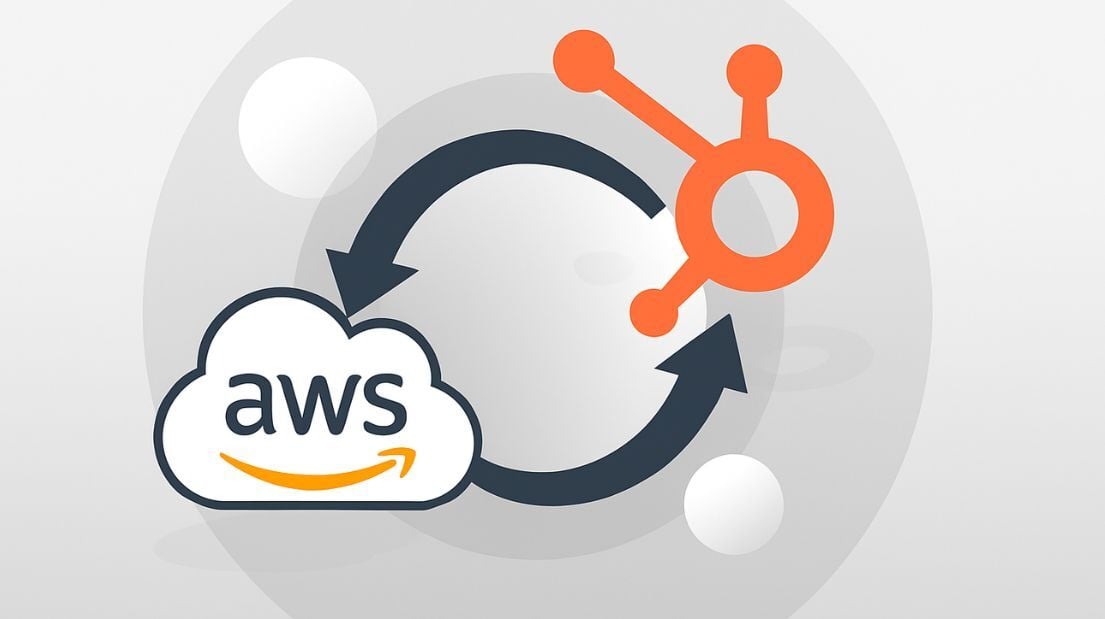
HubSpot is now available on AWS Marketplace.
If that sentence doesn't immediately mean something to you, it probably should. This is especially true if your organisation has a significant AWS cloud commitment and is evaluating (or already using) HubSpot at enterprise scale.
For companies with Enterprise Discount Programmes (EDPs) or Private Pricing Agreements (PPAs) with AWS, this changes the commercial equation around CRM investment.
It means you can potentially fund part of your HubSpot licence through budget that's already been approved, streamline procurement through a channel your finance team already trusts, and accelerate deal timelines that would otherwise take months.
This article explains what's happening, who it's designed for, and how to take advantage of it.
What is AWS Marketplace and why should CRM buyers care?
AWS Marketplace is Amazon Web Services’ digital procurement channel. It lets organisations discover, purchase, and manage third-party software directly through their AWS account.
Think of it as a curated software catalogue that’s integrated into your existing AWS billing and procurement infrastructure.
For IT and procurement teams at large organisations, the appeal is straightforward: fewer vendor contracts, consolidated billing, pre-vetted security and compliance, and, very importantly, the ability to count software purchases towards existing AWS spend commitments.
That last point is the one that matters most here.
Many large companies sign multi-year agreements with AWS, committing to spend a minimum amount on cloud services, often tens of millions of pounds.
These agreements are typically called Enterprise Discount Programs (EDPs) or similar structures. In return, the company gets significant discounts on AWS infrastructure.
The catch? If they don’t hit the committed spend, they effectively waste money. This is where AWS Marketplace delivers immediate value: qualifying third-party SaaS purchases, including HubSpot, now count towards that commitment.
What does this mean for an enterprise HubSpot investment?
Let’s make this concrete, because “HubSpot” can mean very different things depending on scope. A single Marketing Hub Starter licence is a few hundred pounds a year. That’s not what we’re talking about.
An enterprise-scale HubSpot implementation — the kind that involves Marketing Hub Enterprise, Sales Hub Enterprise, multi-region deployment, data migration from Salesforce or Dynamics, custom integrations, and ongoing managed services — typically runs into tens or hundreds of thousands of pounds in licensing alone.
When you add implementation, training, and change management, the total programme cost for a mid-market to enterprise organisation is frequently in the £75,000–£150,000+ range.
That’s the kind of investment where procurement processes get complex. Budget approvals take time. Finance teams want to know why this CRM and not another. IT security needs to vet a new vendor. Legal needs to review contracts.
AWS Marketplace compresses much of that friction.
When you purchase HubSpot through AWS Marketplace, the licence cost flows through your existing AWS billing relationship. If your company has an EDP, up to 25% of your AWS credits can be applied towards the purchase.
Security and compliance are pre-approved through AWS’s vetting process. And because AWS is already an approved vendor in most enterprise procurement systems, the contracting and legal review process is dramatically simplified.
A deal that might have taken four to six months through traditional procurement can close in weeks.

Three reasons this matters for enterprise buyers
1. You can use existing committed cloud spend
This is the headline benefit. If your organisation has committed to a certain level of AWS spend and you’re looking at ways to maximise that commitment, purchasing HubSpot through AWS Marketplace lets you put approved budget towards your CRM investment.
For finance teams, this is a fundamentally different conversation. Instead of "we need a new budget for a CRM platform", it becomes "we can fund this from cloud infrastructure spend that’s already been allocated". That distinction can be the difference between a project that stalls in budget approval and one that moves forward.
2. Procurement gets dramatically simpler
Enterprise software procurement is slow for good reasons — security vetting, legal review, vendor onboarding, and payment terms negotiation. But when your company already has a procurement relationship with AWS, buying software through their marketplace inherits much of that existing infrastructure.
You get single-vendor billing through AWS. Security and compliance vetting is already handled as part of the marketplace listing process. Standardised contract terms reduce legal back-and-forth. And your finance team gets consolidated visibility over software spend through a billing relationship they already manage.
For organisations with large IT procurement teams and cloud-first policies, this isn’t a marginal improvement — it removes entire steps from the buying process.
3. Deal timelines shrink
This is the practical consequence of the first two points. When the budget is pre-approved and procurement is streamlined, the time from “we’ve decided on HubSpot” to “we’re live” gets substantially shorter.
This matters particularly at the end of financial quarters and fiscal years, when teams are trying to maximise cloud consumption against their commitments. HubSpot becoming a viable marketplace purchase gives enterprises another lever to pull during those periods.
Who is this designed for?
This isn’t for every HubSpot buyer. It’s specifically designed for a particular company profile:
Large tech and SaaS companies that already run most of their infrastructure on AWS and have heavy annual cloud spend. These organisations often have multi-million-pound AWS commitments and are actively looking for qualifying marketplace purchases to optimise that spend.
Enterprises with significant AWS cloud agreements across industries like financial services, healthcare, manufacturing, retail, media, and telecommunications. These are companies where AWS is embedded into operations, procurement is centralised, and new software purchases are evaluated through the lens of existing vendor relationships.
Companies that centralise procurement through cloud marketplaces as a matter of policy. A growing number of large organisations use cloud marketplaces as their primary software procurement layer: fewer contracts, consolidated billing, and centralised spend tracking.
For these companies, HubSpot’s availability on AWS Marketplace isn’t just convenient; it’s a prerequisite.
The common thread is cloud maturity. We're talking about organisations with significant AWS infrastructure, centralised procurement processes, and the kind of enterprise complexity where commercial mechanics matter as much as the underlying software choice.
If your organisation doesn't have an AWS cloud commitment, the marketplace route offers less direct financial benefit, though the procurement simplification may still be valuable.
What’s available on AWS Marketplace today
HubSpot has listed several products on AWS Marketplace, including Smart CRM Professional, Smart CRM Enterprise, Sales Hub Enterprise, and HubSpot Credits. Enterprise-tier products are the most relevant here, given the deal sizes and company profiles involved.
What is Smart CRM?
Smart CRM is HubSpot's AI-native CRM core; the foundation that Marketing Hub, Sales Hub, Service Hub, Content Hub, and Operations Hub all run on top of.
It unifies company, contact, deal, and ticket data in a single object model, with HubSpot's Breeze AI layered across it for tasks like data enrichment, summarisation, and agent-based workflows.
The Enterprise tier of Smart CRM is designed for large organisations with complex operations and includes enterprise controls such as sandboxes, granular permissions, secure data storage, and governance tools.
That aligns closely with the kind of HubSpot implementation that benefits most from the AWS Marketplace procurement route.
A note on why this fills a gap
Until HubSpot’s arrival on AWS Marketplace, the CRM options available through this channel were limited. Salesforce has been there for some time, and there were smaller CRM products, but there wasn’t a strong mid-market to upper mid-market option.
That matters because the companies most likely to benefit from marketplace procurement, i.e. those with significant AWS commitments and cloud-first policies, are often exactly the companies that find themselves in the mid-market sweet spot.
Too large and complex for lightweight CRMs, but looking for something more usable, more integrated, and more cost-effective than Salesforce’s enterprise tier.
HubSpot’s positioning on AWS Marketplace fills that gap. For companies already evaluating a move from Salesforce to HubSpot, the availability of a streamlined procurement route through AWS may be the factor that tips the decision.
How to explore this route
If this is relevant to your organisation, there are a few practical steps worth taking:
Check your AWS agreement. Does your company have an EDP, PPA, or similar cloud commit agreement with AWS? If so, what’s your current utilisation against that commitment? Your cloud operations or finance team will have this information.
Confirm marketplace eligibility. AWS Marketplace purchases counting towards the cloud commit depend on your specific agreement terms. Verify that third-party SaaS purchases qualify under your arrangement.
Understand what you need from HubSpot. The AWS Marketplace route is most valuable for enterprise-scale HubSpot deployments — Marketing Hub Enterprise, Sales Hub Enterprise, multi-Hub bundles, or full-platform implementations. If you’re evaluating HubSpot at this scale, the procurement and budget benefits are significant.
Talk to a HubSpot implementation partner. The marketplace handles licensing and procurement, but it doesn’t handle implementation. You still need someone to design, build, migrate, and optimise your HubSpot environment, especially at enterprise scale.
That’s where working with an experienced partner makes the difference between a smooth deployment and a costly false start.
How Huble can help
Huble is HubSpot's 2024 Global Partner of the Year and a HubSpot Elite partner, with offices across six locations on four continents and ISO 27001:2022 + ISO 9001:2015 certifications across every location.
We specialise in exactly the kind of complex, high-value HubSpot deployments where the AWS Marketplace procurement route adds the most value: multi-Hub enterprise implementations, Salesforce-to-HubSpot migrations, multi-region rollouts, and ongoing managed services through our Huble Flex retainer model.
If your organisation has an AWS cloud commitment and is evaluating HubSpot at enterprise scale, we can help you navigate both the implementation and the procurement route.
Our team can advise on scoping, architecture, data migration, change management, and the conversation with HubSpot about your buying path.
Get in touch to discuss how purchasing HubSpot through AWS Marketplace could work for your organisation.

.png?width=500&height=320&name=Image_1__How_to_Get_Your_Brand_Cited_in_AI_Search_in_6_Simple_Steps_(2026).png)