Every enterprise marketing team is now asking the same question: how do we show up when buyers ask ChatGPT, Gemini or Perplexity about our category?
The tools to answer that question have arrived fast. HubSpot launched its own AEO solution in April 2026.
Standalone platforms like Peec AI and Profound have been building in this space for over a year. And the established SEO suites (Semrush, Ahrefs, BrightEdge) are bolting on AI visibility modules of their own.
For marketing leaders evaluating where to invest, the real question isn't which tool has the best dashboard. It's which approach fits the way your team already works, the data you already have, and the outcomes you're actually trying to drive.
Over the past 12 months, the Huble SEO team has been testing a range of AEO software to understand the scenarios for which they are most suited. Based on experience so far, here's how we'd frame that decision.
The landscape in three categories
The AEO tool market has settled into three fairly distinct tiers, and understanding which tier a tool sits in helps you evaluate it properly.
CRM-native AEO (HubSpot AEO) is integrated within an existing marketing and CRM platform. Its advantage is context: it draws on your CRM data (contacts, deals, products, customer segments) to suggest which prompts to track and where to focus.
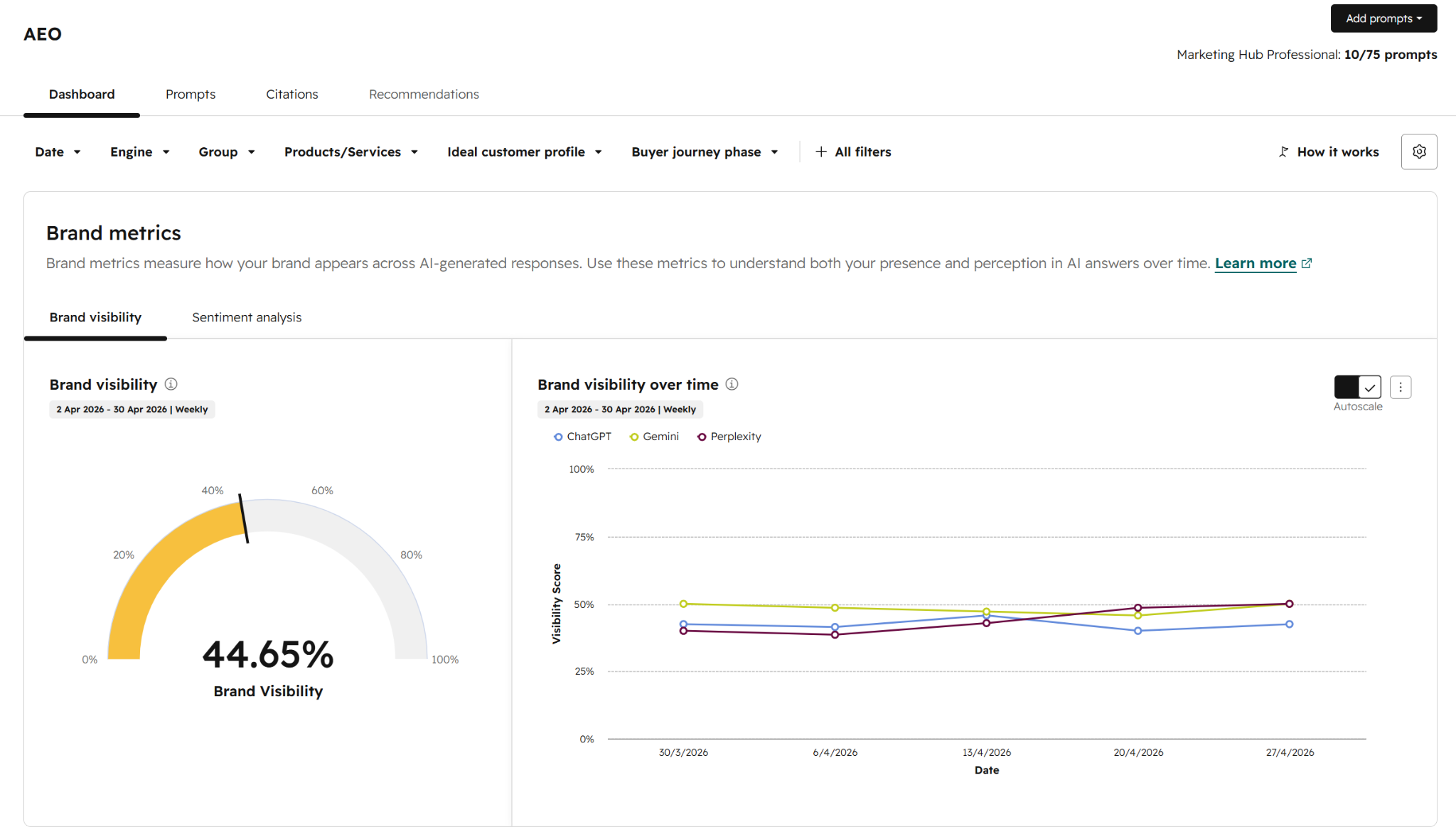
It also connects insight to execution, so when a gap is identified, you can create content, publish social posts or update pages without leaving the platform.
The trade-off is that it monitors fewer AI engines than the dedicated tools and is naturally tied to the HubSpot ecosystem.
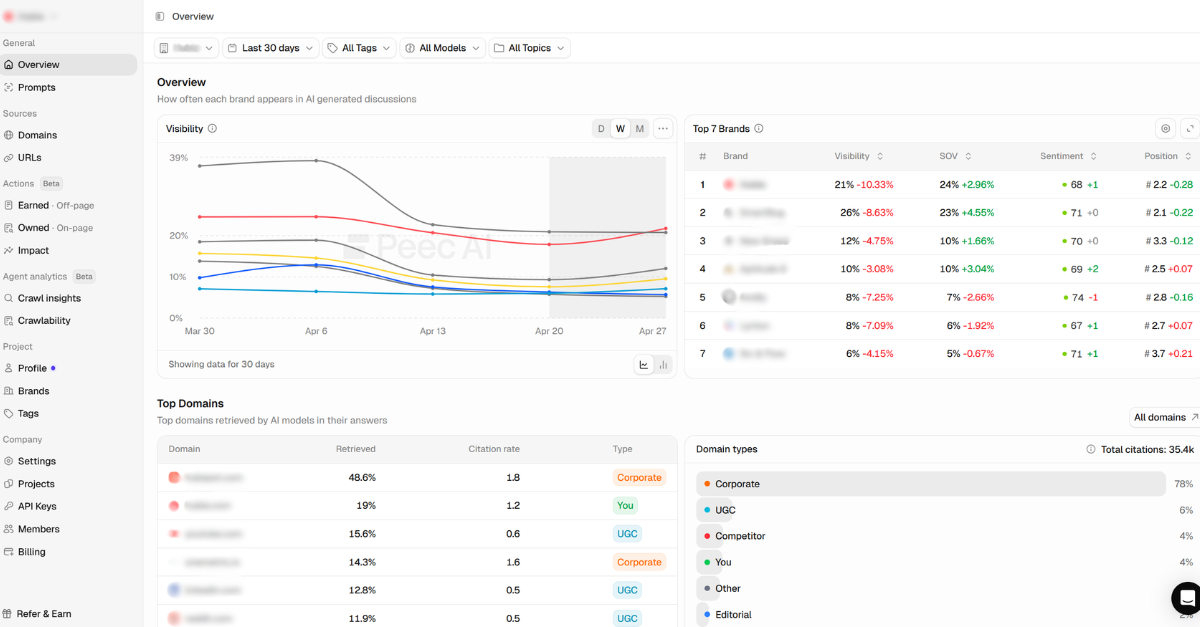
Purpose-built AEO platforms (Profound, Peec AI, Scrunch, Otterly, ELELEM) are dedicated visibility trackers. They typically cover more AI engines, offer deeper competitive benchmarking, and provide granular citation analysis.
Profound skews enterprise: SOC 2 Type II compliance, prompt volume datasets drawn from hundreds of millions of real conversations, and content workflow automation through its Agents feature.
Peec AI occupies the mid-market: cleaner interface, transparent pricing starting around €85/month, unlimited seats, and strong regional tracking. Neither platform has native CRM integration out of the box, though Profound offers API access for connecting to HubSpot or Salesforce.
SEO suites with AI add-ons (SEMRush, Ahrefs, BrightEdge, SE Ranking, Search Atlas) treat AI visibility as one signal inside a broader search programme. If your team already runs traditional SEO through one of these platforms, the add-on modules can give you a baseline view without adding another vendor. However, it’s important to understand the details of the different packages to find the right one for your needs.
Take, for example, SEMRush One - the name for their combined SEO and AEO software. This provides a good high-level overview of a Brand’s performance in Answer Engines, but without the ability to exclude irrelevant prompts or focus the recommendations on specific products or topics.
To combat this, you can track individual prompts in the same way as you would keywords for more focused and segmented insights. However, even the highest SEMRush One tier only allows 200 prompts to be tracked.
E-commerce enterprises need to track AEO not just at a brand level but also to monitor hundreds or potentially thousands of prompts about individual products. In this scenario, SEMRush Enterprise is the better option, but this increases monthly costs from the hundreds of dollars to several thousand. Getting initial buy-in from stakeholders may be tough.
What actually differentiates HubSpot AEO
HubSpot's entry into AEO is different from the standalone tools in two ways that matter for enterprise teams.
The CRM connection changes that prompt you are recommended to track
Most standalone tools ask you to manually enter the prompts you want to monitor, or generate a list of suggestions based on your website content. That works if you already know how your buyers talk to AI, but many teams are guessing. HubSpot AEO uses what it already knows about your business, your products and your customer segments to suggest prompts grounded in real buyer behaviour.
For teams running HubSpot as their CRM, this removes a significant cold-start problem.
Insight connects directly to execution
When HubSpot AEO surfaces a visibility gap, the intent is that you can act on it inside the same platform: create a blog post, update a landing page, publish a social post. HubSpot has indicated that this execution layer is rolling out through the rest of 2026.
In contrast, Profound and Peec AI are primarily diagnostic. They tell you what's happening. What you do about it requires separate tools and workflows — content platforms, CMS access, project management — which adds friction for teams that don't have a mature content operations function.
The trade-off is coverage. Profound tracks nine or more AI engines and stores screenshots for auditability. Peec AI monitors six engines with daily frequency.
HubSpot AEO currently tracks the three major (ChatGPT, Gemini and Perplexity), which covers the bulk of AI search volume but misses emerging platforms like DeepSeek and Grok.
At this time, the other trade-off is prompt tracking allowance. HubSpot offers a free trial that allows you to track 25 prompts.
Where the standalone tools win
If your primary need is deep competitive intelligence rather than workflow integration, the standalone platforms have clear advantages.
Profound's strength is data depth. Its Prompt Volumes feature draws on over 400 million real AI conversations to show actual search demand, not estimates. For enterprise teams running AEO as a dedicated programme with an analyst resource, that level of granularity is hard to match.
Profound also offers content workflow automation through its Agents feature, which can generate AI-optimised content briefs and drafts at scale.
Peec AI's strength is simplicity and value. It does one thing really well: track how often your brand appears in AI-generated answers, which sources get cited, and how you compare to competitors. For teams that want clean analytics without feature bloat and that handle content creation and execution separately, Peec delivers a strong signal at a lower price point.
But we’re also keeping a very close eye on Peec’s “actions” section (currently in Beta). As this develops and expands it’s going to be interesting to see how it compares with HubSpot’s AEO recommendations and if each tool uncovers different suggestions.
Peec’s unlimited-seat model also makes it attractive for agencies and larger teams where per-seat pricing creates friction. For agencies, Peec’s “pitch projects” feature enables you to collect 14 days of data on a site for pitching the tool to clients, which is a really useful addition.
ELELEM.ai takes an innovatively different approach to prompt generation. Customers can install an Answer Engine on their own website that users can use instead of a search bar. The Answer Engine is powered by your content and any specifics you provide in ELELEM’s settings.
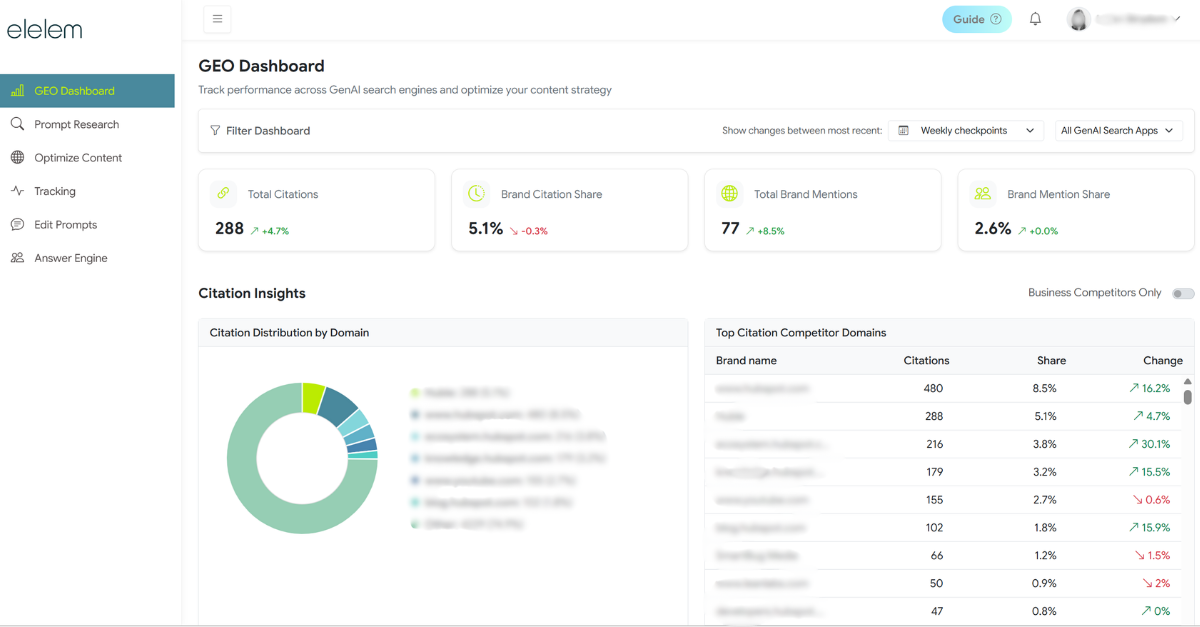
Not only does this provide a next-generation experience to your website visitors, but the prompts they use give you real-time data on what your customers are looking for about your brand. Use this data to guide your AEO strategies using actual customer insights.
These tools also serve teams that aren't on HubSpot. If your CRM is Salesforce, Dynamics or something else entirely, HubSpot AEO's CRM advantage doesn't apply to you, and the standalone platforms become the more natural choice.
The question the tools can't answer for you
Here's what we see across our client base, regardless of which tool they choose: the gap is rarely in measurement.
It's in the operating model that sits behind it.
AEO visibility is a downstream expression of how well your brand, content, data and third-party presence work together. A dashboard will show you the problem.
Fixing it requires alignment across product marketing (who owns the messaging AI summarises), PR and comms (who shapes the coverage AI cites), customer marketing (who drives the reviews and testimonials that influence sentiment), and web and SEO teams (who own the technical signals).
For enterprise teams, three things tend to determine whether an AEO tool delivers value or gathers dust:
Data quality in your CRM. If you're using HubSpot AEO, the prompt suggestions are only as good as the data feeding them. Clean object models, enriched contacts, properly associated deals and reliable segmentation mean the tool reflects real buyer behaviour. Patchy data means patchy recommendations.
Content that answers the questions AI is being asked. Answer engines cite structured, authoritative, specific content. If your site is full of generic educational posts that attract practitioners rather than decision-makers, the tool will surface that gap — but closing it requires a deliberate content strategy shift. We've written about this challenge before.
Cross-functional ownership. AEO is not a marketing task that can be delegated to one person. It touches brand, content, PR, product marketing, customer marketing, web and data. The teams that get consistent improvement are the ones that align all of these around a shared view of AI visibility: with clear ownership of who acts on what, and a regular cadence for reviewing performance.
A practical framework for choosing
Rather than recommending a single tool, here's how we'd suggest enterprise marketing leaders think about the decision:
Choose HubSpot AEO if you're already running Marketing Hub Pro or Enterprise, your CRM data is in good shape, and you want to minimise tool sprawl. The AEO tool is already included in these packages, so you have nothing to lose!
For those with smaller HubSpot licences, the $50/month standalone option also makes it a low-risk pilot for teams who want to start measuring AI visibility without a large commitment. It's particularly strong for teams that lack dedicated AEO analysts and want prompt suggestions generated from existing CRM data rather than manual configuration.
Because the number of prompts you can track is small, we recommend clients use HubSpot to track their highest priority prompts. These should be a mix of purchase-driven questions about their brand, and comparison questions where users are comparing the market vs. their top competitors.
This turns the HubSpot AEO tool into a weekly temperature check of AEO health and performance vs. competitors for the prompts most directly tied to lead generation and revenue.
Choose a tool like Profound or SEMRush Enterprise if you're running AEO as a dedicated enterprise programme, you have analyst resources to work the data, you need SOC 2 compliance, and you want the deepest competitive intelligence available. Be prepared for a longer onboarding cycle and higher cost — realistic spend starts around $400–500/month for meaningful coverage and could go into the thousands of dollars per month.
Choose Peec AI if you want clean mid-market analytics at a transparent price point, you're an agency managing multiple brands, or you want to get up and running quickly without enterprise complexity. Peec is a monitoring and recommendations tool rather than an execution platform, so pair it with a separate content and optimisation workflow.
Layer them if the budget allows. Some of our clients run HubSpot AEO for CRM-powered insight and execution, alongside Profound or Peec for broader competitive monitoring. The tools aren't mutually exclusive, and the overlap is smaller than you'd expect.
And also consider additional tools like ELELEM, for the Answer Engine plug-in mentioned earlier. The deep content analysis and recommendations based on real user data that ELELEM offers are an edge on the competition for any team writing content for SEO/AEO.
How Huble can help
As a former HubSpot Global Partner of the Year and an Elite implementation partner, we work with mid-market and enterprise teams to turn AEO from a dashboard into a working capability.
That means helping you choose and configure the right tooling for your stack, audit the data and content foundations that determine whether any AEO tool delivers real value, and build the cross-functional operating model that connects visibility insight to execution across marketing, Creative, Branding, and web, all the way through to Sales and Revenue.
Read more about Huble’s AEO Services, or watch our webinar on Visibility in AI Search featuring myself and experts from HubSpot, SEMRush and ELELEM.
If you'd like to talk through which approach fits your business, or you want a second opinion on how ready your HubSpot environment is for this next wave, get in touch with our team.

.png?width=500&height=320&name=Image_1__How_to_Get_Your_Brand_Cited_in_AI_Search_in_6_Simple_Steps_(2026).png)